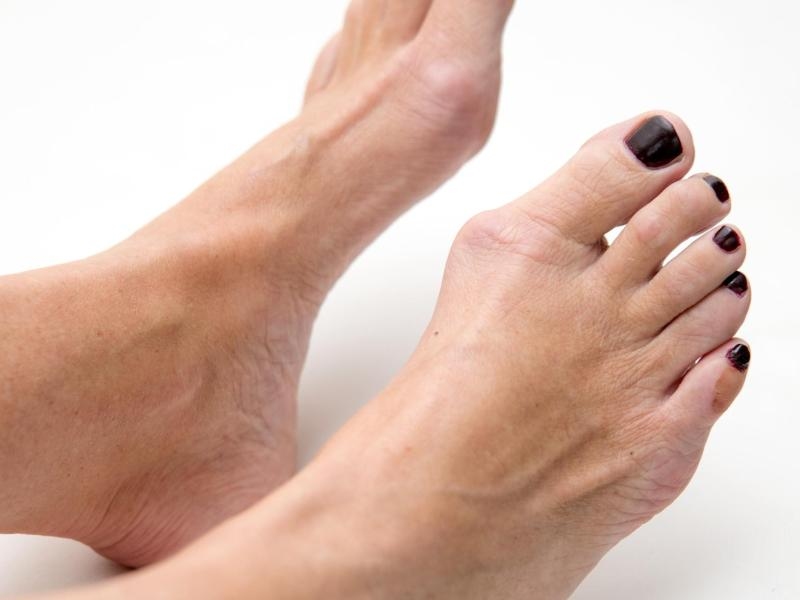
"Hallux Valgus" is a Latin word and "hallux" means great toe and "valgus" means outward. In combination, hallux valgus means outward deviation of the great toe leaving the inner part of the great toe more prominent.
There is no clearly defined underlying pathology for the development of hallux valgus. Although genetic factors are proposed, they are not clearly proved. However, a close relation between shoe-wear habit and hallux valgus development is present. The most strong evidence supporting this relation is that, this deformity is almost never seen in African tribes where there is no shoe-wear. As the women become more active in working life and begin to use high heeled shoes with narrow box, the incidence of hallux valgus deformity increases correspondingly.
Hallux valgus is a progressive disease, so that not every deformity has the same severity. The grading of the deformity is made according to the angles. The angle between the great toe bones less than 10 degrees is regarded as normal. If the angle is 20 degrees, it is called as mild, 20-35 degrees as moderate and over 35 degrees is regarded as severe hallux valgus deformity.
Although most patients consult for cosmetic appearance, the main complaint that must be taken into consideration is pain. The prominent part of inner side of the great toe that is irritated by shoe wear becomes red and tender. With time, as the deformity increases, callosities and deformities of the other toes become prominent.
At the beginning of the deformity, relax shoe wear is strongly advised for both decreasing the complaints and progression of the deformity. The bursitis that occurs due to shoe irritation benefits from cold application. Night splints and toe separation devices may be tried but they are difficult to use and their benefits are doubtful. Instead of passive correcting devices, active exercising of the great toes by stretching them may be more effective.
In progressed cases, surgery is the only solution. There are several corrective osteotomy methods according to the severity and location of the deformity. Each surgical technique has unique advantages and must be done in professional hands. Since hallux valgus is a progressive disease, the surgical treatment shouldn't be postponed till to the severe stage because surgery will be more difficult and the results may not always be satisfactory.